
For UK agencies, consultancies, and professional services firms — a practical guide to real-time project profitability monitoring.
Most professional services firms don't lose money because they lack talented people. They lose money because they discover problems too late.
By the time a project is complete, the damage has already been done. Extra hours have been worked, scope has expanded, deadlines have slipped, and profit has quietly disappeared.
The reality is that project profitability isn't determined at the end of a project — it's determined every single day throughout its lifecycle.
If your business relies on consultants, engineers, developers, project managers, or other billable professionals in the UK or further afield, understanding the health of your projects in real time can make the difference between a profitable year and one filled with write-offs.
Why Do Profitable Projects Become Unprofitable?
Most projects don't suddenly become loss-making overnight. Instead, profitability is gradually eroded by dozens of small decisions that often go unnoticed:
- Additional meetings that weren't budgeted
- Scope changes accepted without reviewing their financial impact
- Underestimating delivery effort at the outset
- Delays waiting for client feedback or approvals
- Internal administration consuming billable time
- Team members working extra hours to meet deadlines
Individually, these may appear insignificant. Collectively, they can remove the entire profit margin from a project.
The Hidden Cost of Waiting Until the End
Many UK organisations still review project performance after invoices have been issued or once the project has been delivered. By then it's impossible to recover lost margin. Questions such as "why did we exceed the budget?" or "why weren't more hours anticipated?" become lessons learned — not opportunities to act.
The most successful professional services firms monitor profitability continuously, not retrospectively. Real-time project budget tracking is no longer a luxury reserved for large enterprise PSA tools — it's a baseline expectation for any agency or consultancy that takes financial performance seriously.
Five Warning Signs Your Project Is Losing Money
1. Hours Are Increasing Faster Than Progress
If you've consumed 70% of your allocated hours but completed only 40% of deliverables, the project is already drifting away from its original plan. Without visibility, teams often continue working until the budget is exhausted — with no warning until the final reconciliation.
2. Scope Creep Has Become Normal
Clients naturally request additional work throughout a project. A quick meeting. One more report. A small enhancement. A final review. Each request appears reasonable. Without tracking their cumulative impact on effort and budget, these additions quickly become significant unplanned work — and unplanned write-offs.
3. Team Utilisation Is Declining
Highly skilled consultants and engineers should spend the majority of their time delivering value to clients. When increasing amounts of time are consumed by administration, internal meetings, rework, or chasing approvals, profitability inevitably falls. Understanding where your team's billable capacity is actually going is fundamental to protecting margin.
4. Budget and Actual Costs Are Diverging
One of the clearest indicators of project health is comparing planned effort against actual effort — week by week, not month by month. Small differences are expected. Large differences require action. Monitoring these trends early enables project managers to have informed conversations with clients before problems escalate into write-offs.
5. Decisions Are Based on Guesswork
Many UK agencies and consultancies still rely on spreadsheets, disconnected reports, and manual calculations. This often means managers only receive meaningful information days or weeks after work has been completed. By that point, the decisions that could have protected margin have already been made — badly, or not at all.
Why Real-Time Visibility Matters
Imagine discovering halfway through a project that delivery costs are already exceeding the agreed budget. At that point, you still have options: you can review project scope, reallocate resources, discuss changes with the client, improve utilisation, or adjust future planning.
Now imagine discovering the same issue after the final invoice has been sent. There are very few options remaining.
Visibility creates opportunities. Delay creates write-offs.
This principle holds whether you're a 10-person digital agency in Manchester, a 50-person IT consultancy in London, or a professional services department within a larger UK organisation. The earlier you understand where profitability is at risk, the more tools you have to protect it.
Building Better Project Intelligence
Modern project management platforms for professional services should do more than record time — they should surface meaningful insight into project health while there is still time to act.
By bringing together time tracking, project management, resource planning, approvals, and reporting in a single platform, professional services teams gain a clearer understanding of:
- Project profitability — live margin per project based on actual hours versus billing rates
- Budget performance — RAG health scores (Red, Amber, Green) updated in real time
- Resource utilisation — billable versus non-billable time per team member
- Delivery trends — burn rate, milestone status, and predictive budget exhaustion dates
The objective isn't to collect more data. It's to make better decisions, earlier — before client projects move from amber to red, and before the invoice reveals what the reporting should have shown weeks ago.
What Hourglass Was Built to Solve
Hourglass is a professional services delivery, utilisation, and profitability platform built specifically for UK agencies, consultancies, and engineering firms. Its core premise is simple:
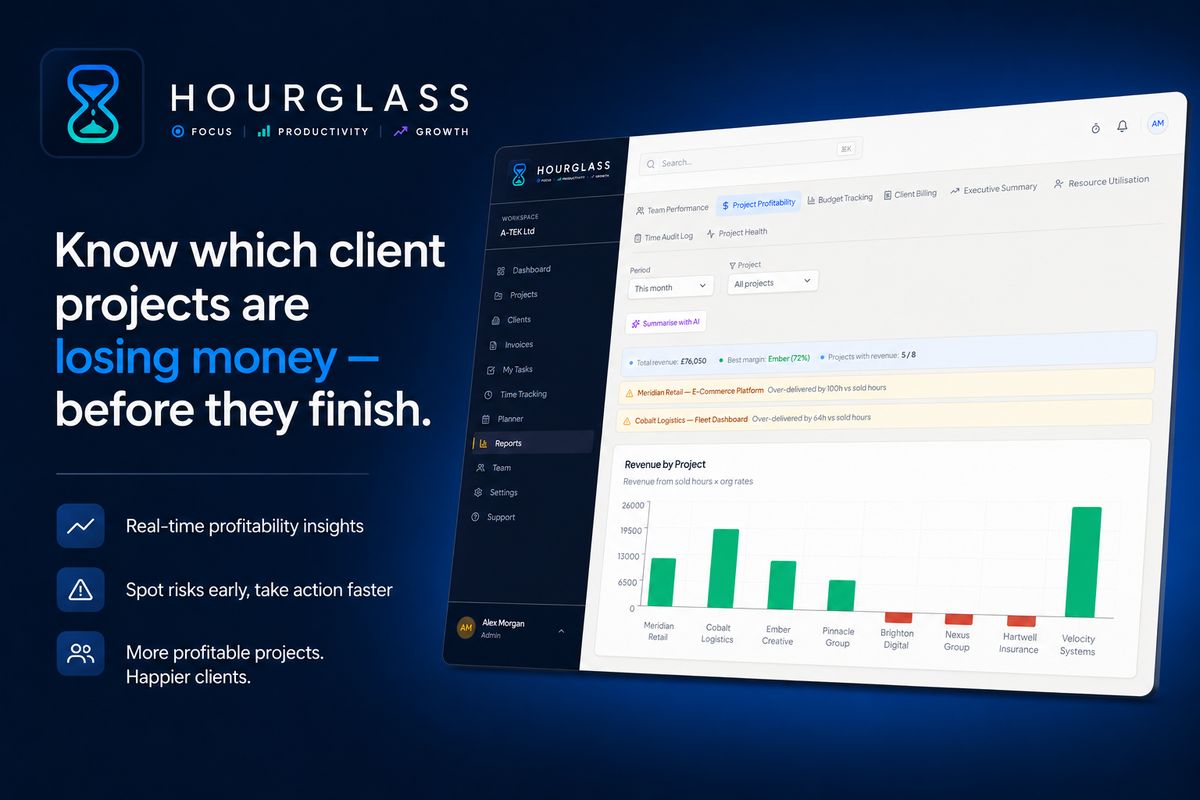
Know which client projects are losing money — before they finish.
Rather than waiting for the month-end reconciliation, Hourglass gives project managers live RAG health scores, budget burn rates, and AI-powered risk analysis across every active project — so risks are visible weeks before they become incidents.
The AI Budget Risk Analysis feature analyses burn rates across every active project and identifies which ones are at risk of overrunning before it happens — factoring in current budget consumption, recent weekly spend velocity, and time remaining. In practical terms, a Monday morning portfolio review that previously took 45 minutes now takes 5.
Predictive budget exhaustion dates are calculated automatically based on four weeks of actual burn data and displayed directly on the budget report and project health dashboard. No formula. No spreadsheet. Just the date, visible when it matters.
Learning Through Real-World Feedback
We're currently working with a professional services organisation that is trialling Hourglass as part of its day-to-day operations. Their feedback has reinforced something we've believed from the beginning: teams don't need more reports. They need timely, actionable insights that help them identify risks before they become costly problems. That ongoing collaboration continues to shape the future direction of the platform.
Final Thoughts
Every professional services business measures success differently. Some focus on utilisation. Others prioritise customer satisfaction or revenue growth. But one metric remains universal: project profitability.
The earlier you understand whether a project is succeeding financially, the more opportunity you have to improve the outcome. Waiting until the project has finished is no longer a viable strategy.
The future of project management isn't simply tracking what happened. It's understanding what's happening now — and what needs attention next.
About Hourglass
Hourglass is a project management and time intelligence platform designed for professional services organisations across the United Kingdom. Available at hourglass.syncrasoft.com — Starter plan free, no credit card required. Pro from £12 per user per month.