
Category: Agency Management | Read time: 10 min | Published: 1 July 2026
Running a UK agency without real-time profit data is like driving with your eyes closed. You win the project, deliver the work, send the invoice — and only discover months later that the margin was quietly negative the entire time. Project profitability software built for agencies closes that gap by turning your time entries and billing rates into live profit-and-loss figures per project, so you can act whilst there is still time to make a difference.
Why Agency Profitability Is Harder Than It Looks
The challenge with measuring project profitability in a UK agency is not the arithmetic — it is the data. Hours are logged in one system, invoices are raised in another, and billing rates live inside someone's head or a locked spreadsheet. By the time you piece it all together, the project is closed and the margin has already been lost.
Fixed-price projects are the worst offenders. A project sold for £15,000 looks straightforward until you add up the actual hours: scoping calls that overran, revision rounds that doubled the design effort, a client who wanted weekly status meetings that were not included in the original estimate. Without software tracking that burn in real time, you only learn the true cost when the timesheet exports arrive at month-end — long after there was anything useful to do about it.
Time-and-materials projects carry the opposite assumption: because every hour is billed, teams believe margin is always healthy. What this misses is the volume of non-billable activity that surrounds every T&M engagement — account management, quality review, internal briefings, and rework driven by unclear requirements — that erodes effective utilisation and, with it, the firm's actual profitability.
Research consistently shows that over 60% of professional services projects exceed their original time estimate. The agencies that manage this effectively are not those with the most experienced project managers — they are the ones with the clearest real-time data on where hours are going, and the operational discipline to act on it.
What Project Profitability Software Does Differently
Purpose-built project profitability software for agencies connects your team's time logs directly to your billing rates and project budgets. Every hour logged becomes an immediate cost signal. Every milestone invoiced is tracked against planned revenue. The result is a live margin figure, updated continuously, rather than a retrospective calculation completed long after the work is delivered.
The key distinction from a basic time tracking tool is context. A time tracker tells you how many hours were logged and on which project. Profitability software tells you what those hours cost relative to what the project is worth — and whether you are on track to deliver the agreed scope within the agreed budget before the budget is exhausted.
The long-term benefit is perhaps even more valuable: when you know which project types, client industries, and team compositions historically deliver the best margin, you can make informed decisions about what to pitch for and at what rate — rather than guessing based on instinct and hoping for the best.
Key Features To Look For in Agency Profitability Software
- Budget tracking with RAG status (Red, Amber, Green) — see at a glance which projects are on track, approaching their ceiling, or already overrun, without opening a spreadsheet.
- Per-person or per-role billing rate management — a blended average rate produces misleading margin calculations on any project with a mixed team.
- Planned versus actual hours comparison by project phase — track drift before it becomes a crisis.
- Client billing report export in PDF and CSV compatible with Xero, without manual re-entry of timesheet data.
- Contractor and freelancer rate tracking — day rates, hourly rates, and fixed-fee contractors all applied at the correct cost automatically.
A Practical Framework for Calculating Project Margin
Step 1 — Establish cost rates for every grade. For each employee, calculate the true cost per hour: annual salary plus employer National Insurance (13.8% above the secondary threshold), pension contributions, and a proportional allocation of overhead. A senior consultant on a £65,000 salary might cost the firm approximately £50 per hour all-in.
Step 2 — Set the project budget before any work begins. If you have sold 80 hours of senior consultant time at £150 per hour (£12,000 contract value), your cost ceiling is 80 hours × £50 = £4,000, giving a target gross margin of £8,000 (67%).
Step 3 — Track hours against budget at least weekly. Configure notifications when 50% and 75% of the project budget are consumed — these thresholds give you time to have a commercial conversation with the client or adjust the delivery approach.
Step 4 — Review variance at the phase level, not just the project total. A project on budget overall might have a discovery phase at 140% of its hours allocation with delivery not yet started — a signal you want to see before committing the timeline to the client.
Step 5 — Build a profitability retrospective into every project close. Compare planned margin to delivered margin. Over time, this becomes your most valuable pricing intelligence.
Common Mistakes Agencies Make With Profitability Tracking
- Using a single blended billing rate across the whole team
- Not tracking non-billable time against specific projects
- Reviewing profitability data monthly rather than weekly
- Ignoring contractor costs in the margin model
- Confusing revenue with margin
Why UK Agencies Need UK-Focused Profitability Software
Most project profitability software is built for the North American market. UK-specific requirements include: VAT-inclusive and VAT-exclusive reporting; financial periods aligned to the UK tax year (April to March); invoicing exports compatible with Making Tax Digital; IR35 status tracking for contractors; and GDPR-compliant data handling with UK or EEA data residency. GBP pricing matters for budgeting certainty — a tool priced in US dollars is a variable cost that shifts with the exchange rate.
How Hourglass Tracks Agency Profitability in Real Time
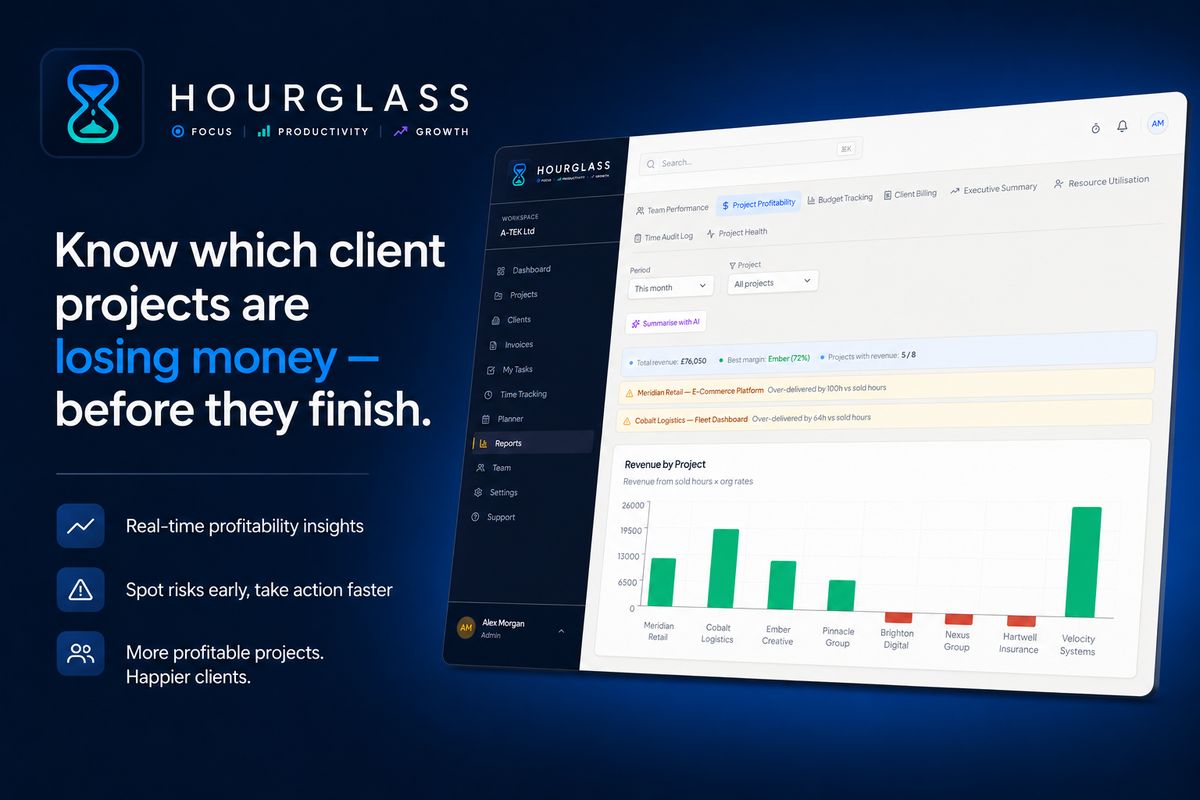
Hourglass was built specifically for UK professional services agencies. Each project receives a budget expressed in hours or monetary value. Team members log time against it, and the platform calculates live margin using each person's individual billing rate — updated the moment a timesheet entry is submitted. When a project hits 75% of its budget, the status turns amber. At 90%, it turns red. No exports, no formulae, no waiting until month-end. Hourglass integrates directly with Xero and generates client billing reports in PDF and CSV format.
Frequently Asked Questions
What is the difference between project profitability software and time tracking software?
Time tracking software records hours and what they were spent on. Profitability software applies billing rates and cost rates to those hours, compares the resulting figures to your project budget, and tells you whether the project is on track to be profitable. A time tracker answers "how long did this take?" — profitability software answers "are we making money, and will we finish before the budget runs out?"
How often should I review project profitability data?
For active projects, review planned versus actual hours at least weekly. For shorter projects of under six weeks, review every two to three days. A monthly cadence means overruns are discovered too late to act on.
Is project profitability software expensive for a small agency?
Enterprise PSA platforms can cost tens of thousands of pounds per year. Purpose-built tools for small UK agencies — including Hourglass — are priced per seat in GBP, typically £10 to £30 per user per month, with no implementation cost and no long-term contracts. For most agencies, catching a single significant project overrun a fortnight earlier than you would have done without the software substantially exceeds the annual subscription cost.
Hourglass is a professional services delivery platform built for UK agencies and consultancies. Start your free trial at hourglass.syncrasoft.com — no credit card required.