
Category: Financial Management | Read time: 10 min | Published: 5 July 2026
Tracking project profitability in a consultancy is one of the most commercially important disciplines you can establish — and one of the most consistently avoided. Projects feel profitable whilst they are happening: the team is busy, the client is engaged, invoices are going out. The discomfort tends to arrive weeks or months later, when someone finally adds up the hours and discovers the margin was far lower than expected, or was negative entirely.
This guide provides a practical, step-by-step framework for measuring project margin as work happens — not after the damage is done. It is written for UK consultancy principals, finance leads, and operations managers who want to move from retrospective reporting to live commercial visibility.
Why Most Consultancies Struggle With Profitability Tracking
The barriers are rarely about capability — they are almost always about process and data infrastructure.
- Fragmented data — time is logged in one system, project plans live in another, invoices are raised in a third, and billing rates exist in a spreadsheet that was last updated by someone who has since left.
- Cultural discomfort with tracking — there is an implicit belief in many consultancies that rigorous financial tracking is incompatible with a high-trust professional environment. The opposite is true: a team that understands project economics makes better decisions about scope, pace, and priorities.
- Insufficient granularity in time logging — if your team logs time to "Project X" without distinguishing between phases, activities, or individuals, the resulting data cannot tell you where overruns are coming from.
Step 1: Define Your True Project Costs
True project cost includes direct staff time at cost rate (not billing rate), calculated as annual salary plus employer National Insurance (13.8% above the secondary threshold as of 2026–27), employer pension contributions, and a proportional allocation of overhead. For a consultant on a £55,000 salary, true employment cost including NI, pension, and overhead is likely to be £70,000–£75,000 per annum — approximately £40–£45 per hour after dividing by billable working hours.
Also include: contractor and freelancer fees, project-specific software licences, management and account coordination overhead, and all expenses including travel and accommodation.
Step 2: Set a Budget Before Work Begins
Every project should start with a formally agreed budget before any work commences. Without a baseline, there is no way to measure whether you are on track or adrift. For fixed-price projects, translate the contract value into hours at cost. Document the budget in the same system where time is logged — not in a separate project plan that nobody reads after kick-off.
Step 3: Track Time Against Budget in Real Time
The most common failure in consultancy profitability management is that time is tracked diligently but nobody looks at it until the project closes. Establish a clear review cadence:
- Projects of 1–3 months: review planned vs actual hours weekly, by phase.
- Projects of 3+ months: review bi-weekly with a monthly summary.
- Short projects under 4 weeks: review every 2–3 working days.
Each review should address three questions: How many hours have been logged against budget? How does consumption by phase compare to the plan? If current trends continue, will the project be delivered within budget?
Step 4: Apply Billing Rates to Calculate Live Margin
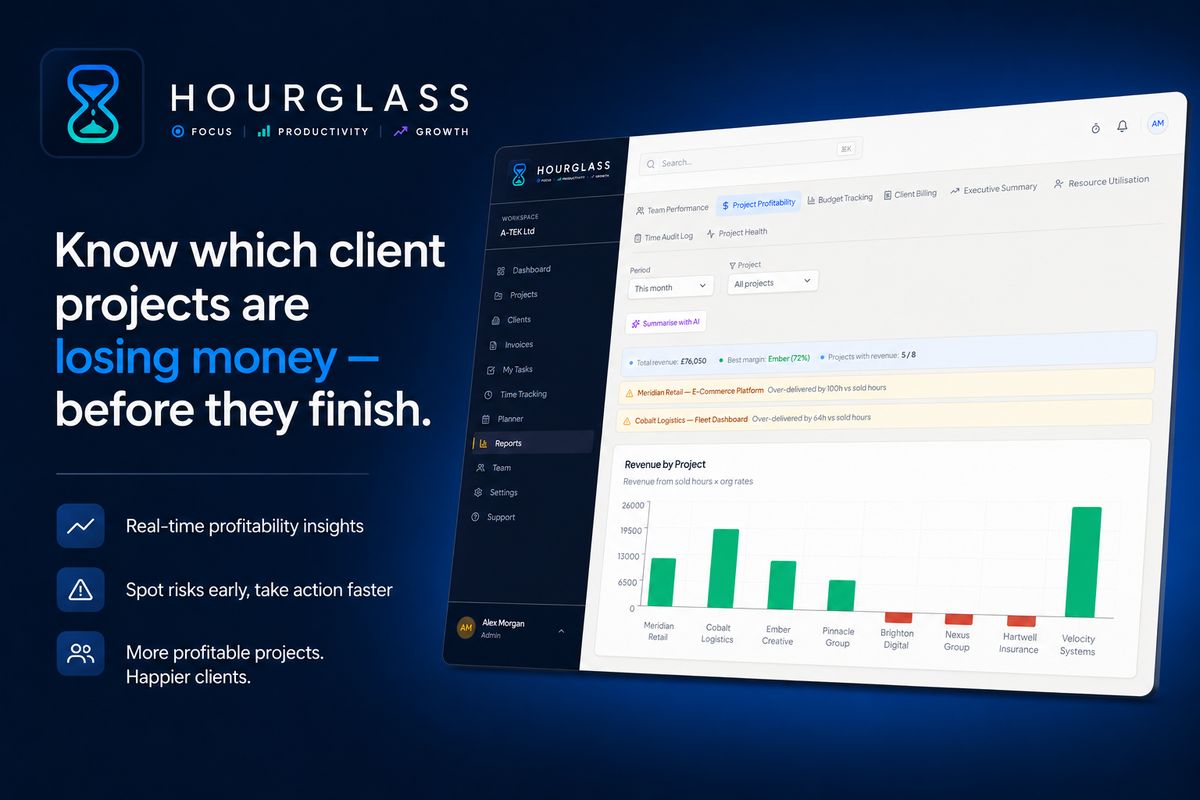
Apply each person's billing rate to calculate the revenue value of time delivered, and their cost rate to calculate the actual cost. The difference is your live gross margin. This calculation must happen at the individual level, not at a blended average, if your team has meaningful variation in seniority and rates. Express margin both as a percentage of revenue and in absolute pounds.
Step 5: Use RAG Status to Prioritise Your Attention
A sensible threshold for most UK consultancies:
- Green: below 70% of budget consumed.
- Amber: 70–90% consumed — review required. Understand what drove consumption and whether remaining scope can be delivered within remaining budget.
- Red: above 90% consumed, or already overrun — immediate action required. Escalate to a senior decision-maker and consider a client conversation about scope or additional investment.
Step 6: Build a Profitability Retrospective Into Every Project Close
A formal 30–60 minute retrospective with the account lead and project manager at every project close answers four questions: What was the planned margin at the start? What was the delivered margin at close? What were the top two or three causes of any variance? What would we do differently when scoping a similar project?
Over time, this database of outcomes by project type becomes your most valuable pricing intelligence — allowing you to price future work with genuine evidence rather than optimistic estimation.
Frequently Asked Questions
What is the difference between project profitability and project margin?
Project margin typically refers to gross margin — revenue minus direct costs of delivery — expressed as a percentage of revenue. Project profitability is broader and may also include overhead allocation and indirect costs. For most consultancies, tracking gross margin per project is the right starting point.
What should I do when a project is forecast to overrun?
You have three options: reduce the remaining scope (deliver less than planned to stay within budget), absorb the overrun (accept lower margin and learn from it), or have a commercial conversation with the client about additional investment. The important principle is to make this decision actively and early — not discover the overrun after the fact.
How do I track profitability across a project with multiple phases?
Set a sub-budget for each project phase that reflects the hours planned for that phase. Track consumption at the phase level. This makes it possible to identify which phases consistently overrun and investigate whether it is a scoping problem, a process problem, or a client behaviour pattern.
Hourglass is a professional services delivery platform built for UK agencies and consultancies. Start your free trial at hourglass.syncrasoft.com — no credit card required.